Beyond the Breakwaters – How Chennai Port’s Infrastructure Drive is Reshaping Regional Trade and Prosperity
By S Viswanathan IAS, Deputy Chairperson of Chennai Port Authority and Managing Director of Maritime India Foundation.
 Indian Ports today are not just gateways for cargo — they are development anchors, driving regional growth, empowering industries, generating employment, and shaping the nation’s destiny. This transformative role is rooted in India’s maritime heritage. During the Chola era, ports like Nagapattinam and Kaveripattinam were thriving centres of trade and culture, linking India with Southeast Asia and spreading language, art, and culture across the seas.
KEY DRIVER OF REGIONAL COMMERCE, INDUSTRIAL GROWTH
Chennai Port carried forward this legacy. What began in 1639 with the establishment of Fort St. George as a modest trading outpost evolved into a manmade all-weather harbour by 1881, when the construction of protective breakwaters transformed the storm-battered coast of Madras into a safe and reliable maritime gateway. Over the decades, strategic expansions such as the Jawahar Dock for bulk cargo, the Bharathi Dock for crude oil handling, and the commissioning of India’s first container terminal in 1983 have turned Chennai Port into a key driver of regional commerce and industrial growth, anchoring South India’s trade and logistics ecosystem.
Now entering its 144th year, Chennai Port is charting a new era of growth through five strategic verticals — Port Modernization, Connectivity Enhancement, Sustainability, Coastal Community Development, and Global Trade Linkages.
INTEGRATED LOGISTICS ECOSYSTEMS
Ports today are no longer just berthing points for ships — they areintegrated logistics ecosystems. A single vessel carrying 3,500 TEUs demands coordination equivalent to a minimum of 1,750 trucks, where even a few minutes of delay can ripple across supply chains. India has already made great progress — logistics costs, once around 14% of GDP, have dropped to 7.97%, as per the DPIIT–NCAER 2025 report — a testament to our improving efficiency.
Chennai Port is leading this transformation through key connectivity projects. The 20.93 km Chennai Port–Maduravoyal Elevated Corridor, with separate tiers for port-bound and city traffic, will provide a signal-free link to national highways by 2028, reducing congestion and cutting transit times. Complementing it, India’s first operational greenfield Multimodal Logistics Park (MMLP) coming at Mappedu by 2026 — will have warehousing, cold-chain, and container handling facilities, enabling seamless intermodal connectivity.
KEY CONNECTIVITY PROJECTS
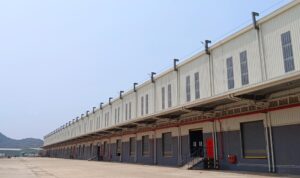
Under the Port Modernization vertical, Chennai Port is enhancing capacity and efficiency through focused upgrades. Warehouses are being developed for sensitive cargo like cold-rolled steel coils, alongside open paved yards for project cargo such as wind turbine blades. The Cruise Terminal is being upgraded to promote tourism. The buffer parking yardhave reduced trailer transit times by eliminating congestion along EMRIP Road – the main highway leading to port entry gates. An indigenous Vessel Traffic Management System (iVTMS), developed with NTCPWC, IIT Madras, is improving navigation safety. Since 2023, Chennai Port has also emerged as a bunkering hub on the east coast, with a dedicated berth supporting cleaner marine fuels.
GREEN INITIATIVES
Under its Sustainabilityvertical, Chennai Port is advancing green initiatives in line with the Harit Sagar Guidelines, including a 500 kW rooftop solar plant and an additional 2 MW rooftop solar project under implementation, reinforcing its focus on renewable energy and carbon efficiency. Shore power supply has been introduced for naval vessels and port crafts, reducing emissions during berthing and marking a major step toward sustainable and energy-resilient port operations.
Recognizing the deep interdependence between the port and the coastal community, Chennai Port is modernizing the fishing harbour with an investment of Rs. 116 Crores with upgraded landing facilities, ship lifting facility, and hygienic auction halls to empower fishermen and Chennai’s blue economy — ensuring growth that is inclusive and human-centered.
MARITIME VISION 2047
Beyond its coastline, The Chennai–Vladivostok Eastern Maritime Corridor is set to redefine India’s trade connectivity, offering a route that is 45% shorter than the Mumbai–Saint Petersburg linkand reducing transit time by up to 16 days. The corridor will facilitate the movement of coal, crude oil, LNG, fertilizers, and containerized exportssuch asauto components and processed food, significantly lowering ocean freight costs. By linking India’s east coast with Russia’s Far East, the corridor expands Chennai Port’s global trade reach and anchors India’s presence in the Indo-Pacific vision of shared growth and maritime cooperation.
Implementing such large-scale transformation requires collaboration between government, industry, academia, and global partners. The upcoming India Maritime Week (IMW) — to be held from October 27–31 at NESCO, Mumbai — embodies this collaborative spirit. With participation from over 100 countries and investment commitments worth nearly ₹10 lakh crore, IMW will catalyze partnerships that accelerate Chennai Port’s modernization journey.
As India sails toward Maritime Vision 2047, Chennai Port stands as a symbol of continuity — rooted in heritage, powered by technology, and driven by collaboration. Much like the tides it commands, its story flows from the past to the future — carrying forward the promise of trade, prosperity, and progress for South India and beyond.
About The Author