Australia Suspends 60% of Indian Fumigation Service Providers
Chennai:
Port Wings News Network:
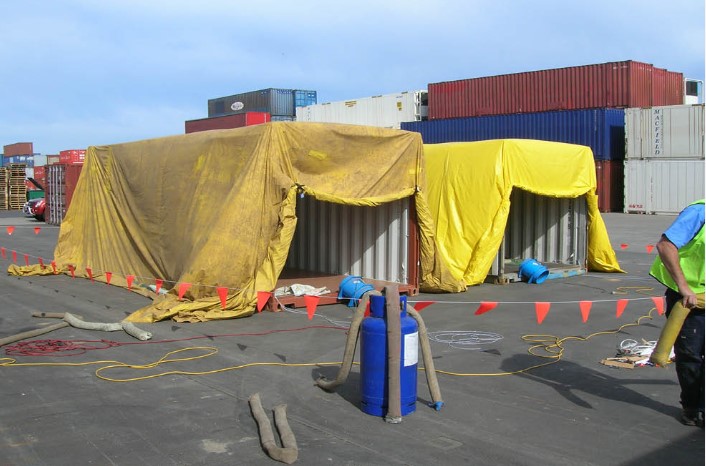
Image Credit: DAFF, Australia
Australia has suspended the licences of 60 per cent of fumigation service providers in India, after an audit by Australian biosecurity, says a report in leading daily The HinduBusinessLine.
The suspension of these 44 service providers, including 5 from Haryana and 3 from Punjab, was made last week. This could result in some exporters having to pay additional charges for refumigation of the consignments once it lands in Australia.
Containers in transit are not exempt from such division. If any suspended fumigation provider fumigates a consignment, it would have to be refumigated in Australia on arrival.
“This process will add up additional cost of fumigation…,” the department said. The additional costs could vary from (Australian dollar) A$700 to A$1,200 per container. (A$1=₹66.14).
The owner of a fumigation agency, which services channel partners of some leading Basmati exporters, said on the condition of anonymity that officials conducted the inspection on July 2 and verbally communicated their decision the next day. Though he is yet to receive any formal communication from the Australian authority, he also saw it on their Website.
1-time exemption
Over 100 containers of Basmati rice will likely be affected by this suspension. If one container of Basmati rice is valued at $22,000, at least ₹200 crore worth of consignments are at risk of either getting rejected or made to go through the costlier re-fumigation, said an affected exporter.
According to a communication from the Australian Department of Agriculture, Fisheries and Forestry, during the past few years, Canberra has moved from document-based approval toward continuous compliance monitoring and surprise audits. Australia operates one of the world’s strictest biosecurity systems. Even relatively small procedural failures may result in suspension.
Basmati rice exporters expressed concern over the development, saying re-fumigation would result in additional costs for them. Haryana and Punjab exporters said they have taken it up with APEDA (Agricultural and Processed Food Products Development Authority of India) and the Union Ministry of Agriculture, as its plant quarantine wing is the main body governing fumigation.
Sources said the government is considering seeking a one-time exemption for rice shipments in transit and certified by the suspended entities.
The fumigation firm owner said the Australian authorities got suspicious after they found a discrepancy in the dates of fumigation and packing. They wondered how consignments could be packed earlier than the fumigation date. The owner, who fumigates 5-6 containers of Bbasmati a month, said that while fumigation is done when the rice is in gunny bags, the agency had no clue how the exporter packs the aromatic rice.
Agri import norms
Fumigation is a method to control the presence of pests in agricultural produce using methyl bromide and aluminium phosphide when a consignment is shipped or stored. Pests tend to get into the consignment during the transit period, which continues for days.
One fumigator in South India confirmed that its fumigation services had been suspended by Australia.
Australian biosecurity regulations require managing any risk if a treatment provider fails to comply with the country’s import conditions, scheme requirements, or the relevant treatment methodology.
Agri exports top $500 m
India’s exports to Australia exceed $500 million a year. In the previous fiscal, shipments to Canberra totalled about $520 million, with Basmati rice topping the basket at $79 million, followed by miscellaneous processed items at $75 million and spices at $73 million.
Trade experts said the India-Australia Economic Cooperation and Trade Agreement (ECTA) has a mechanism under Chapter 13 (Dispute Settlement) to tackle such issues. The chaper mandates consultations before taking punitive trade action. The consultation requirement is generally intended for systemic trade grievances or disputes.
“However, under WTO and ECTA SPS rules, Australia can implement provisional biosecurity bans without prior warning if there is an imminent risk to domestic ecosystems,” said an expert who did not wish to be identified.
Indian Prime Minister Narendra Modi should raise this issue during his current visit Down Under, the expert said.
Upcoming CECA meet
S Chandrasekaran, a New Delhi-based trade analyst, said the forthcoming India-Australia Comprehensive Economic Cooperation Agreement (CECA) should consider a special chapter on pre-border Biosecurity and Quality Control and Schemes Cooperation.
“Such a chapter could provide joint accreditation and periodic audits of offshore treatment and inspection providers, notification and technical consultation before suspension, except in genuine emergencies,” he said.
He said time-bound corrective action opportunities for first non-critical breaches should be provided, mutual observation of audits by officials from both countries should be permitted, and an expedited reinstatement mechanism after compliance should be verified. Experts said India sends enormous volumes of cargo requiring offshore treatment. Larger numbers naturally generate more inspections and, therefore, more consignments are detected for non-compliance.
About The Author