CII, CWC Jointly Host Stakeholder Consultation Meet to Strengthen Agri Export Logistics
Chennai:
Port Wings News Network:
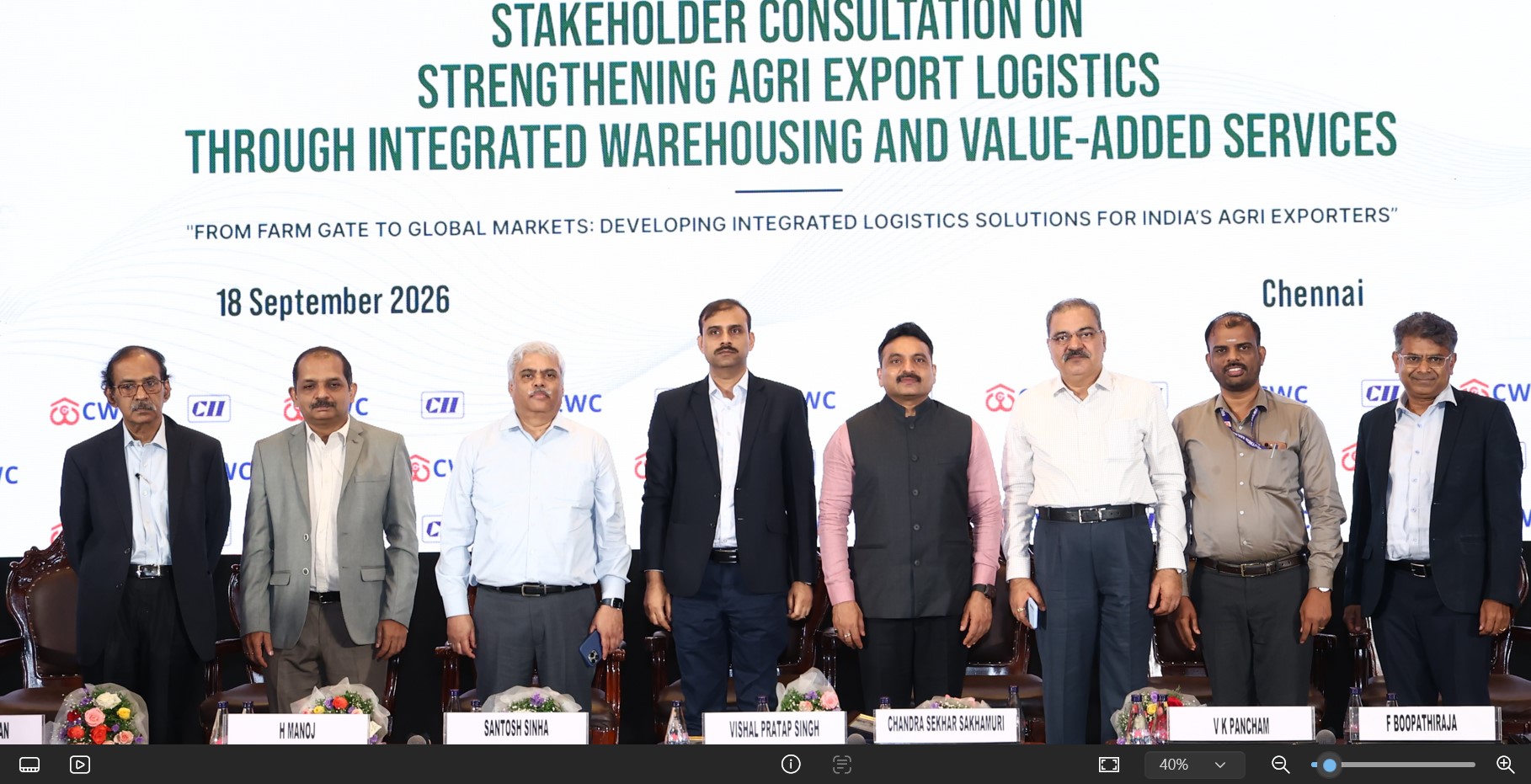
(L to R) : S Chandramohan, Past Chairman, CII Tamil Nadu & Group President – Finance TAFE – Tractors and Farm Equipment Limited; H Manoj, Chief General Manager NABARD Tamil Nadu Regional Office NABARD; Santosh Sinha, Managing Director, Central Warehousing Corporation; Vishal Pratap Singh, IRS, Commissioner of Customs Chennai-IV (Export) Commissionerate, CBIC, Chandra Sekhar Sakhamuri, IAS, Director, Department of Agriculture Marketing & Agri Business Government of Tamil Nadu; V K Pancham, Regional Director – Southern Region Food Safety and Standards Authority of India (FSSAI); Boopathiraja, Deputy chief operations manager (freight operations) Southern Railway; Jaisinh Vaerkar, Co
Convenor CII Tamil Nadu Agri & Food Processing Panel & Chairman Thillais Masala at the Stakeholder Consultation meet.
Access to adequate, affordable and timely capital for farmer producer organisations (FPOs), together with better processing and preservation at the farm gate, is essential to strengthening agricultural value chains and connecting farmers with global markets, Chandra Sekhar Sakhamuri, IAS, Director, Department of Agricultural Marketing & Agri Business, Government of Tamil Nadu, has said.
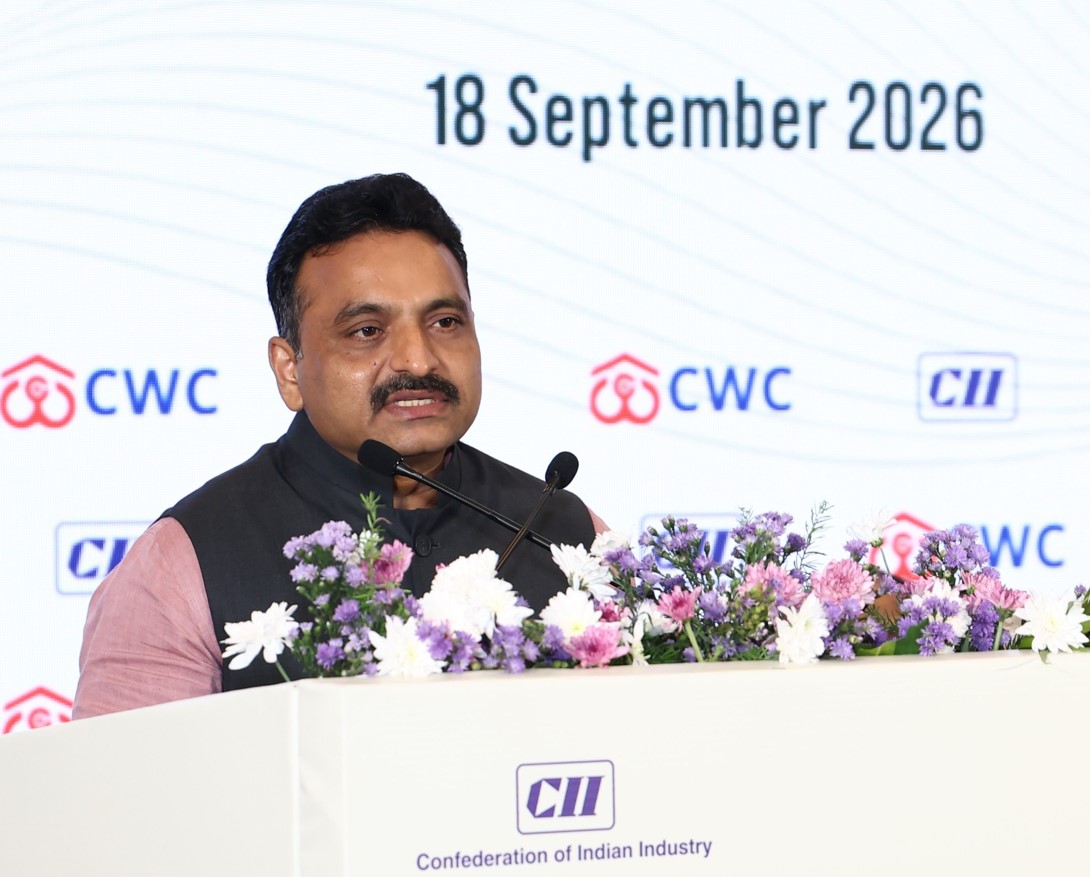 Delivering the keynote address at the “Stakeholder Consultation on Strengthening Agri Export Logistics Through Integrated Warehousing and Value-Added Services”, organised by the Confederation of Indian Industry (CII) jointly with Central Warehousing Corporation (CWC) on 18 September 2026 in Chennai, Chandra Sekhar Sakhamuri said, “Stakeholder consultations undertaken by the department have identified access to finance as a central challenge for FPOs, particularly when they aggregate farmers’ produce during the procurement season.”
The theme of the event was “From Farm Gate to Global Markets: Developing Integrated Logistics Solutions for India’s Agri Exporters”.
Chandra Sekhar described how FPOs were progressing from supplying agricultural inputs to aggregation, sorting, grading and processing, with some developing their own brands and becoming established exporters.
“Tamil Nadu had made substantial progress in agricultural marketing through the expansion of electronic trading and the development of FPOs. However, gaps remained in preservation, value addition and access to export markets, requiring coordinated action by government agencies, financial institutions, logistics providers and farmer organizations,” he added.
Drawing attention to losses during handling and transportation, he further said activities such as sorting and grading could be undertaken at the farm gate to reduce damage as produce moved through successive stages of the supply chain. “Such losses represent not only wasted produce but also the loss of farmers’ investment, labour and the resources committed to cultivation, with implications for both food and nutritional security,” he pointed out.
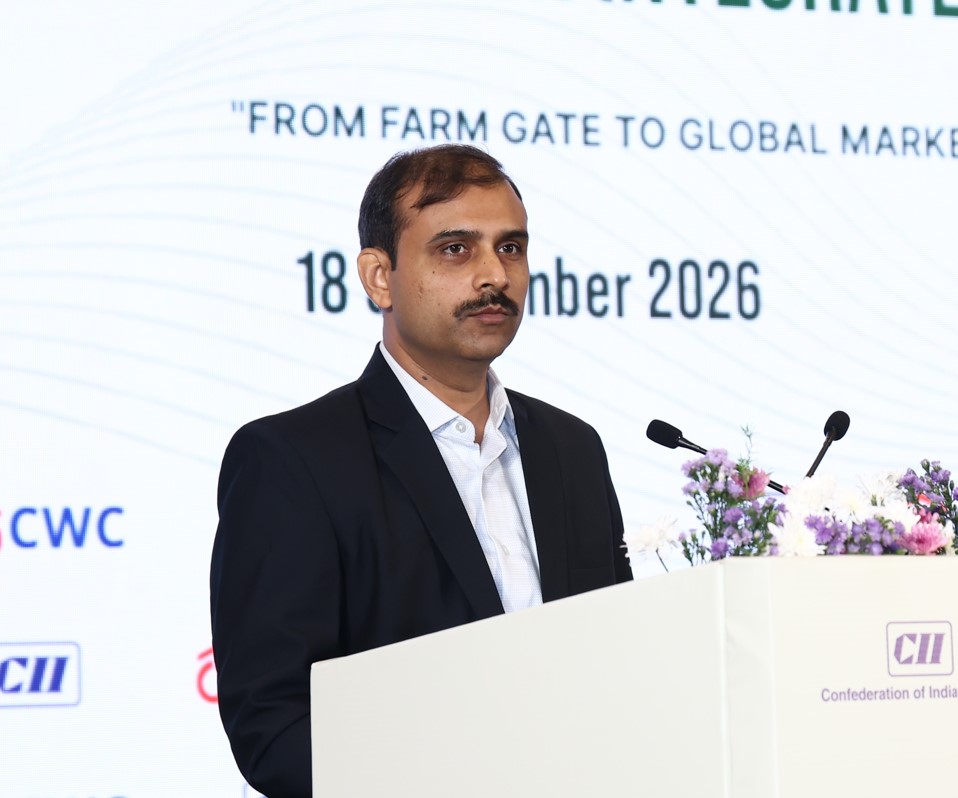 Vishal Pratap Singh, IRS, Commissioner of Customs, Chennai-IV (Export) Commissionerate, Central Board of Indirect Taxes and Customs (CBIC), Ministry of Finance, Government of India, said, “Agricultural exports remain critical to livelihoods and employment, even as economies diversify. Processing and value addition, alongside the promotion of organic and Geographical Indication (GI) tagged products, are important avenues for reducing wastage, expanding exports and developing markets with sustained demand.”
Highlighting Customs’ increasing emphasis on trade facilitation, he outlined measures including priority clearance for perishables, round-the-clock operations at designated facilities and the Single Window Interface for Facilitating Trade, which brings approvals from participating government agencies onto a common platform. He urged exporters to use self-sealing permissions and Direct Port Entry to facilitate faster movement from factories to ports and reduce logistics costs.
Santosh Sinha, Managing Director, Central Warehousing Corporation, said CWC aimed to bring together its capabilities in scientific storage, cold chains, cargo handling and multimodal transportation to provide integrated logistics services for horticultural exports.
He invited stakeholders to identify infrastructure and service gaps, including opportunities in Chennai, to help develop an actionable plan linking production centres with export gateways while preserving produce quality.
H Manoj, Chief General Manager, NABARD, Tamil Nadu Regional Office NABARD, in his speech, said NABARD supported the agricultural value chain through financing for rural infrastructure, storage, processing and climate-resilient investments, alongside assistance to FPOs, cooperatives and agri-startups. With around 300 NABARD-promoted FPOs representing approximately two lakh farmers in Tamil Nadu, he sought closer collaboration with CII and other stakeholders to connect their products to export markets and strengthen GI-based market opportunities.
V K Pancham, Regional Director, Southern Region, Food Safety and Standards Authority of India (FSSAI), said food safety and logistics efficiency were inseparable, as breaks in cold chains, unhygienic storage and unsuitable packaging could lead to shipment rejections and damage the reputation of Indian exports. He called for temperature-monitored warehousing, end-to-end traceability, trained handlers and closer coordination among regulatory agencies and logistics partners.
M Boopathiraja, Deputy Chief Operations Manager (Freight Operations), Southern Railways, Chennai, proposed identifying commodity-specific corridors and developing rail-linked agri-export hubs with facilities for aggregation, grading, storage, cold chains and container handling. He suggested identifying priority commodities and routes, designating coordinating teams, developing operating and cost models, and launching a seasonal pilot with committed cargo partners.
Setting the stage with his opening remarks, S Chandramohan, Past Chairman, CII Tamil Nadu & Group President – Finance, TAFE – Tractors and Farm Equipment Limited, outlined six priorities for strengthening agricultural exports: integrated agri-logistics hubs, commodity-specific corridors, infrastructure closer to farmers, value addition, partnerships across the supply chain, and measuring outcomes beyond export value.
He stressed that progress should also be assessed through reduced post-harvest losses, improved farmer realisations, shorter transit times, lower logistics costs, fewer shipment rejections, longer shelf life, greater value addition and increased participation of small producers in export markets.
Jaisinh Vaerkar, Co Convenor, CII Tamil Nadu Agri & Food Processing Panel & Chairman, Thilais Masala, delivered concluding remarks.
About The Author